
Digitalization in ceramics is no longer an option but a structural necessity—one that System Ceramics anticipated and interpreted early by developing solutions that answer to the growing complexity of manufacturing processes.
The Smart Factory is not an abstract concept: it is the ceramic industry’s answer to the growing complexity of manufacturing processes. The integration of sensors, robotics, artificial intelligence and sophisticated control systems across the entire value chain has transformed factories into interconnected digital entities where every machine communicates, every process generates data and every item of data informs a decision.
With the Transition 5.0 Plan launched in 2024, the Italian ceramic industry has received a further incentive to invest in technological innovation, energy efficiency and sustainability. Digitalisation is no longer merely a tool for competitiveness, but a lever to reduce consumption, emissions and waste, in full alignment with the principles of the fifth industrial revolution.
In this scenario, the role of technology providers has changed profoundly. Rather than simply supplying high-performance machinery, they must anticipate market changes, understand the needs of ceramic manufacturers before they are explicitly expressed and develop solutions capable of evolving in step with the sector. This is precisely the approach adopted by System Ceramics (a Coesia Group company) ever since it embarked on its Smart Factory journey.
GENYA: a solution based on listening
In 2020, as glazing lines became increasingly complex, longer and more technologically demanding, they also became more difficult to manage manually. In response, System Ceramics developed Genya, a hardware and software system designed for tracking ceramic surfaces and synchronising applications along the line. This was not a reactive fix for an existing problem, but a proactive solution for an emerging requirement.
Initially designed for large formats, where the complexity of synchronisation is most evident, its modular architecture has gradually expanded its scope to include more dynamic production runs and smaller formats. Since its launch, the system has undergone constant evolution, adapting to changes in technology and production requirements, and responding flexibly to the challenges of an increasingly dynamic sector where demand dictates rapid changes in format, design or technical specifications. System Ceramics has progressively integrated this capability by listening closely to the specific needs of its customers.
Centralised control: simplifying complexity
Genya responds to a very real challenge: glazing lines have expanded and evolved considerably, incorporating a growing number of technologies that require constant coordination. Managing this complexity manually leads to inefficiencies, errors and wastage of both time and resources.
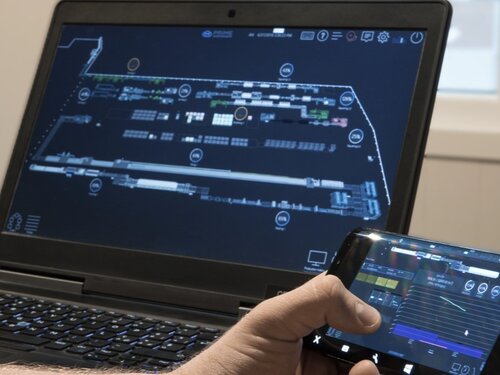
Genya resolves this by centralising the control of all System Ceramics machines in the glazing area through a single, intuitive interface. This architecture improves efficiency and quality and reduces waste and energy consumption, while ensuring total traceability and operational flexibility, even when production layouts change.
Total traceability: from qr-code to production record
One of the areas where System Ceramics’ forward-thinking approach is most visible is traceability. Genya has introduced QR code tracking, which involves marking each ceramic surface with a unique code that is read at the machine entrance. The software knows exactly which process to apply to each product, even when printing different faces of the same pattern, as every single face is tracked individually for every surface present on the line.
This brings immediate operational benefits. A tile can be removed from the line, tested and reinserted without causing any misalignment in the production sequence, eliminating the need for manual monitoring and drastically reducing the risk of error. Fewer errors also mean less waste and lower material and energy consumption.
But traceability is not limited to real-time operations given that Genya records printing conditions even many hours after production. Ink temperature, glazing parameters and other critical variables are associated with each tracked surface, allowing irregularities to be detected and the causes of any defects to be traced, even retrospectively. This creates a production record that transforms data into a tool for continuous improvement.
Active optimisation: learning from the field
Rather than developing solutions in the laboratory and then transferring them to the market, System Ceramics evolves them by listening to what is happening on the factory floor. A prime example of this is the synchronisation of printhead cleaning cycles, one of Genya’s most valued features.
In the past, each machine would stop independently for cleaning, resulting in short but frequent stoppages along the line. Genya coordinates these tasks in a single, synchronised stop that allows all machines to be cleaned simultaneously. This seemingly minor detail, when multiplied across daily production cycles, translates into significant time savings, reduced energy consumption and overall process optimisation.
A future-oriented system
Ongoing software developments will further enhance Genya’s capabilities, moving towards complete process traceability and even more detailed parameter monitoring, thereby enabling manufacturers to identify the causes of defects even long after production.
This process of continuous development reflects System Ceramics’ philosophy: not simply delivering a finished product to market, but working with customers to build a system that grows, adapts and looks to the future.
Stay updated on the industry with curated data and insights each month: subscribe to the TECNA Magazine
POWERED BY CWR
PUBLICATION
12/05/2026
Other related news

20/08/2025
Industry and the challenge of artificial intelligence

04/02/2026
Advanced mineral solutions for large slab production

16/02/2026
The sustainable transition in the field of ceramic body preparation

24/03/2026
European construction set for recovery

22/04/2026
Algerian construction industry on the rise

24/06/2026
The Italian ceramic industry is worth €7.5 billion

17/09/2025
The future of construction in Europe between recovery and uncertainty

15/10/2025
Heavy clay machinery: the Italian industry holds its ground in international markets

14/11/2025
Clay building products: trends and figures of the Italian industry

04/12/2025
Not just large formats: the digital revolution also embraces special pieces

10/12/2025
World production of ceramic tiles

12/12/2025
The global exports of ceramic tiles decreased to 2.67 billion sqm in 2024

15/01/2026
The Italian tile industry ends 2025 on a positive note

26/01/2026
Ceramics take center stage in the “total look” of living spaces

19/03/2026
TECNA at Expo Revestir: securing a presence in key markets